Notwithstanding their success, Rome was still regarded as a rube upstart with no culture and full of people who had no appreciation of philosophy. However, when danger loomed, the sophisticated cities of the south called Rome for help. Of course, this is not the same as when the sophisticated Europeans embroiled the whole world in two wars and then looked to the unsophisticated and non cultured US for help...
 |
| Area Sacra Largo di Torre Argentina - area of 4 temples some from 3rd century BC |
At the beginning of the 3rd century BC, the most powerful Greek city-state in the heel of Italy was Tarentum. Tarentum had a treaty with Rome since 302 BC, which denied Romans access to the Bay of Tarentum, where resided the most powerful navy of Italy. It was OK with the Romans, because a) they were not fond of naval warfare and b) any of their naval activity was limited around central Italy.
In the
southeast of Italy also resided Lucanians, Osco-Sabellic people, who were not
fond of the Greek city-states. Lucanians had one overwhelming problem, that is,
they usually allied themselves with the losing sides in the Italic peoples’
wars with Rome, like with the Etruscans. Therefore they turned their military
aggression against the Greeks in southern Italy, to the cities like Locri,
Rhegium, Croton and Thurii. Those cities sent a collective SOS to Rome for help
against the Lucanians.
The
Senate sent an embassy to Tarentum, led by L. Postumius Megellus, to discuss the matter, and to ask for
compensation for the fleet. However, the Roman ambassadors were publicly
insulted, and ridiculed because of their lousy Greek language and
denied audience. It was one of those unfortunate historical mistakes. Some of
the Tarentines realised that this incident means trouble and cast their eyes to
their motherland, the mainland Greece, where the successors of Alexander the
Great were carving out their niches. One of them was king Pyrrhus of Epirus in northwestern Greece. He was an adventurer, who had delusions of being
another Alexander the Great. Pyrrhus accepted the invitation from Tarentum with
alacrity, because he thought that this was the first step on the road to an
empire, which he craved.
In 280
BC Pyrrhus landed in Italy and besides 25 thousand mercenaries, he sported 20
war elephants. Romans had never seen anything like that and even though they
were successful against the Greek phalanx, the elephants created real havoc and
the Romans lost about 7 thousand men. However, Pyrrhus did not destroy the Roman
army, and won just on points. He lost at least 4 thousand of his mercenaries,
and they could not be replaced. His main problem was a wounded elephant, which
went on rampage among his own troops.
 |
| Pyrrhus |
Some of the Samnite tribes, which after their defeat
received only a status of “Friend and Ally’ and not the coveted citizenship,
encouraged Pyrrhus to attack Rome itself. Pyrrhus was convinced that the Latins
would join him (preferably with flower throwing and rejoicing at being freed
from the callous Romans). Though by that time, the Latins could not really
remember the time before they enjoyed Roman citizenship and were members of the
Res Publica. They joined together not against Rome, but against Pyrrhus, and
stopped him about 60 km from Rome. Not to mention, that his attitude ‘I am a
king and you are dirt’ somewhat alienated his Tarentine allies.
 |
| Pyrrhus's movements in Italy |
Another year, another battle. In 279 BC a huge
engagement was fought in Apulia. It lasted two days, the first one a draw. Next
day, the only thing that saved Pyrrhus were his elephants, and Romans had to
withdraw. After surveying his substantially thinned ranks, Pyrrhus declared
‘Another such victory and I am lost”. Since no Roman allies were eager to break
their treaty with Rome and join him, Pyrrhus had no way of replenishing his
troops. Feeling magnanimous, he offered peace terms to Rome. When the Senate debated this offer, and the
opinion seemed to swing in favour of accepting it, the old and blind Appius
Claudius Caecus ordered his sons to lead him into the Senate where he held a
long speech, the topic being: “You fools, whose idiotic idea was it to accept
any offers from Pyrrhus?” In 1st century BC this speech was still
extant and Cicero admired it for its succinctness and inventiveness in the field of insults. This speech put an effective end to peace
offerings, proposals and negotiating and left Pyrrhus high and dry. Because –
what to do? He could not decisively defeat the Romans, he could not get support and he could not replace the experienced mercenaries.
In 275
BC Pyrrhus faced the Roman army at the town of Malventum in southern Italy.
This time, even a “Pyrrhic victory” was elusive. Romans learned to deal with
the elephants by stabbing them with spears into the sides, and Pyrrhus returned
to Epirus without most of his army, without his elephants and quite subdued.
Eventually he mixed himself up in other adventures and was killed by a woman
who threw a roof tile on his head.
The Romans renamed the town of Malventum to Beneventum
(good omen), and offered the usual lenient peace agreement to the defeated
foes. The city of Tarentum was allowed self-rule, received Latin rights, and
other Greek city-states and the remaining Italian tribes surrendered under similar
conditions.
The
victory over Pyrrhus confirmed Rome as master of Italian mainland, and in the
same time confirmed that Appius Claudius had a lot of common sense. Of course,
this mastery of the mainland put the Romans in direct neighbourhood of a
western Mediterranean superpower, Carthage.
Many historians and scholars cannot get their
mind around the fact of Roman success, and try to find combination of reasons
why Rome was so successful in the first centuries of the Republic, especially
considering the number of external enemies and the internal bickering between
various classes of citizens. The said bickering was considerably lessened by the
reforms of 367 BC that provided debt relief, instituted land distribution to
poor citizens and provided plebeians with access to the highest offices of
the state.
The statesmanlike quality of Rome’s leaders was another
part of the equation, with building of strategic alliances and punctiliously
fulfilling their treaty obligations. Rome’s treatment of her neighbours in
Latium secured their loyalty in the long run, not to mention that various
Italian communities found Samnites in the south and Gauls in the north with
their thieving and pillaging ways far less palatable and much bigger threat to
their security than Rome.
Some historians just throw hands in the air and declare
that Rome just had good luck. Considering how long the history of Rome was,
this was one long run of good luck! And since nothing succeeds like success,
Rome attracted immigrants from far and wide. By the year 300 BC Rome's urban
population doubled to 60 thousand from 30 thousand and by 275 BC probably
surpassed 90 thousand and growing.
Growing population meant more housing, more food and especially more water were
needed and Aqua Appia, hailed as such a marvel in 312 BC did not cut it any
more and another aqueduct, Anio, was added and 272 BC.
Romans had literacy from early age, having adapted Greek script to Latin. However, they regarded writing with great pragmatism like anything else. Writing was good to record laws, keep account books and note important events on the chief priest’s ‘white tablets’. Literature was something imported from the Greeks in southern Italy, but that entailed learning Greek. Too much trouble. However, the upper classes appreciated the Greek learning and literature. Especially, since the Greeks perfected the art of oratory and persuasive rhetoric. The rising politicians found it useful when trolling for votes, speaking in the Senate, or at trials.
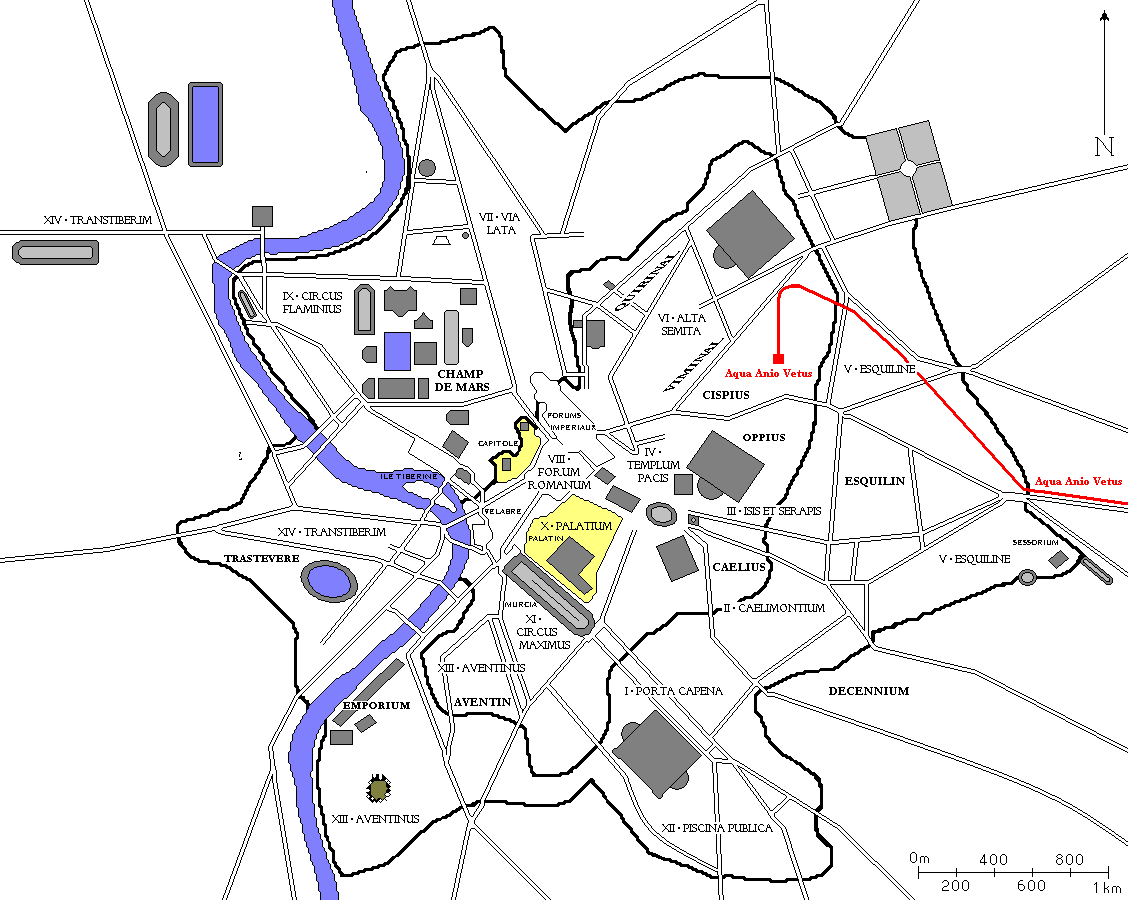 |
| Plan of ancient Rome with the course of Anio Vetus Aqueduct |
Romans had literacy from early age, having adapted Greek script to Latin. However, they regarded writing with great pragmatism like anything else. Writing was good to record laws, keep account books and note important events on the chief priest’s ‘white tablets’. Literature was something imported from the Greeks in southern Italy, but that entailed learning Greek. Too much trouble. However, the upper classes appreciated the Greek learning and literature. Especially, since the Greeks perfected the art of oratory and persuasive rhetoric. The rising politicians found it useful when trolling for votes, speaking in the Senate, or at trials.
One of the first teachers of Greek ways was Lucius Livius
Andronicus. A slave from southern,
Greek, Italy, he was freed, and added the name of his master, Lucius Livius, to his own. He became
not only a teacher of Greek and Latin to teenage boys bent on politics or law
career, but also a translator and adaptor of Greek literature. Thus began Roman
literature – as was usual with the Romans, they imported a useful skill and
developed it.


