Saturday, April 7, 2012

BETWEEN THE WARS.

            The 1st Punic war ended like the WWI in Europe, by total exhaustion of all participants, and was similarly not decisive. The Romans, used to dealing with the defeated Italic tribes and nations, were not really sure how to deal with Carthage.  The Carthaginian empire was defeated, but could it be made into ‘Friend and Ally” like everybody else and reduced to grumbling at election time?
Pont du Garde - part of the 39 km long Roman aqueduct supplying the
city of Nemausus, today Nimes in southern France.

            The Roman Senate vacillated between harsh measures and friendliness. The Romans helped Carthage with their mercenary problem by supplying Carthage, and withholding war supplies from the mercenary army. On the other hand, when the People’s Assembly learnt about the lenient peace treaty, they were not happy and voted for increased indemnity and taking Sardinia and Corsica from Carthage as well.
           
            However – the Carthaginians offset their losses by conquests in Spain, rich in mineral wealth, founded cities like New Carthage (which was a misnomer, because Carthage itself meant unimaginatively ‘New city’ in Punic, therefore New Carthage meant New new city), today’s Cartagena and merrily grew rich. Actually, the whole Spanish enterprise was something like fiefdom of the Barca family, represented by Hamilcar Barca and founding of the city of Barcelona. 

            The Romans viewed this expansion with growing suspicion, fuelled cleverly by Massilian Greeks (today's Marseille), who were afraid of losing their mercantile status. Thus, when the Romans arrived on the international stage, they were presented with a neat array of problems. Like – how to deal with their new overseas provinces? What about the annoyed Roman and Italian farmers, who were the legionnaires in the war and wanted to see some gain? The Gauls did not stop bothering from the north of Italy, and what about the pirates in the Adriatic? How to stop Carthaginian expansion in Spain and thus stop the Massilians sending envoys to Rome every five minutes?
Massilia / Marseille

            The Romans cleverly asked the Sicilians what would they prefer in their new relationship with Rome. They preferred to pay the same tribute to Rome, as they paid before to Carthage or Syracuse, and not to supply soldiers. The system worked this way: every year a census was taken of the farmers. What was sown, what is the expected return, etc.  This record was filed in the governor’s office and one tenth was paid as a tribute to Rome, as was before to Carthage. The Senate then issued an estimate based on 10.4 % of the expected harvest. The 10% went to the State Treasury, the .4 % was for the private contractor, collecting the taxes (Romans did not really believe that the answer to all the ills of the world is bureaucracy).

          The annoyed Roman farmers found their champion in Gaius Flaminius. Tribune of the Plebs Flaminius went over the heads of the Senate and presented a law in the Assembly, to distribute Ager Publicus, or public lands belonging to the state, to poor families. Good show and good intentions – but baaad precedent, and an example for demagogues a century later.

            Gauls in the north of Italy were always studied and watched very carefully, if they keep to the ploughs and not to the swords. They had best intentions to farm and not to draw attention of Rome to themselves, but … There were other Gauls further to the north of them and those Gallic tribes were busy multiplying and expanding, thus pushing the Po Valley Gauls south, and into conflict with Rome. At least, that was the Gallic excuse.

            The Gauls decided that they will have it out with Rome, and united in their righteous yearning for loot. To get it, the united Gallic army moved into Etruria, and as tradition dictated, plundered and pillaged. Etruscans, yelled for help to Rome, their “Friend and Ally”. Two Roman armies converged on the Gauls and annihilated them.


           Senate, in whose care was, according to mos maiorum, the Treasury, found the costs of taming the northern Italian Gauls prohibitive. In the cost/result analysis the Senate decided to civilise the Gauls under the umbrella of Friend and Ally of the Roman People. This task fell to Gaius Flaminius, who was popular thanks to his tribunician actions and managed to reach consulship, and the more conservative senators were happy to stick him with the Gallic problem. 
Senate House still stands. It lost its portico
and its doors (moved to San Giovanni
in Laterano church). Notwithstanding
its uninspiring architecture, it was the
most important place of the Republican
Rome

            And so in 220 BC Rome had a new Italian province, Gallia Cisalpina, or ‘Gaul before the Alps” including the whole Po Valley, and Flaminius was busy issuing tenders for building a consular road, the via Flaminia, starting in Rome (today’s via del Corso), and leading north.  As well, keeping with his revolutionary tendencies, Flaminius reorganised voting ‘tribes’, only they were not tribes, just voting districts where citizens were included upon receiving citizenship, and now did not depend on the address of the citizen. He added some new ones for city dwellers and his most ardent supporters.
Inside Senate House shows that the Senators had to bring
their own chairs, if they wanted to sit. The chairs
had no backs, probably to speed up the debates.

            Then there was the problem of Illyrian pirates. Illyria was a place that was recently called Yugoslavia, and now has number of other names, like Croatia, Slovenia, Montenegro and on and on.  But the geography is the same – hundreds of little inlets and coves, hundreds of little and bigger islands, all so inviting as a refuge to speedy boats waylaying slow merchant ships. While Romans were busy in the west with the Punic war, and the Greek cities under Roman control were weak on the sea, the pirates became bolder, and started to raid eastern Italian seaboard.  Roman Italian allies sped off to Rome to din into senatorial ears with basic message – “what do you mean, we are Friends and Allies, look what the pirates do, and you do nothing!” Closer investigation showed, that the GDP of the Illyrian kingdom was officially supplemented by piratical actions, with part of the booty going to the state treasury of Queen Teuta, residing away from the sea in a mountain fortress.

         In 229 BC the Romans sent an embassy to Illyria with suggestions to the Queen, mainly consisting of “cease and desist”. The Queen was not up on the latest news about the Italian politics and who is the top dog on the Italian peninsula. Her message was, “Leave me alone, you losers!” After about 2 hours of deliberation, the Roman Senate dispatched 200 ships to the island of Corcyra (today’s Korfu), the southernmost Illyrian fort. The fort surrendered without a fight and the Roman fleet sailed north in support of a land army, which was with deliberation (Roman adage was ‘festina lente”, that is ‘hurry slowly’) taking over cities on the sea, like Apollonia and Dyrrhachium. Teuta did not wait until the slowly hurrying Romans take over her mountain seat, and sued for peace.  That was smart, because she retained her crown this way, she only had to promise that the Illyrian GDP will not be supplemented by piracy anymore, and that her forces will not attack Greek cities.
Queen Teuta

            She was smart and kept the treaty. When she died, her adviser, Demetrius, was now adviser to the Macedonian king, mainly advising him to extend his kingdom into Greece, and send pirates out again. Romans this time did not hurry slowly, they hurried swiftly and defeated Demetrius. Demetrius stayed at the Macedonian court and whispered sweet nothings about revenge into the underage ears of new Macedonian king Philip V.


            That happened in the years 220-219 BC. The Romans could not pursue the slow hurrying in Illyria and Macedon further, because some disquieting news came from the western end of the Mediterranean.  The Carthaginian army in Spain under the leadership of young, bold and popular commander Hannibal, the son of Hamilcar Barca, was marching north and besieging a Roman ally, the city of Saguntum.


Saturday, March 31, 2012


Punic Wars

                        There was a balance of power in the western Mediterranean around 264 BC like before WWI in Europe. As in Europe in 1914, this balance of power did not stand up to empire building pressures. An assassination in Sarajevo, or restless puny Greek city-state of Messana – both were the cause of a long drawn war, with inconclusive peace and with a determined man in the defeated nation to “right the  wrongs” and to continue the conflict...


View of the remains of the temple of Saturn, otherwise known as the
State Treasury. It has two underground stories.
1st Punic War

                   Carthage in north Africa (today close to the capital of Tunisia) was founded according to tradition around 750 BC by Phoenician settlers. Called ‘Puni’ by the Greeks and later Romans, they were very business minded and built up a mercantile empire in the western Mediterranean, with attending naval expertise. Rome and Carthage had few problems between them because each had its own spheres of interest. While Rome was busy staying above the water under constant attacks from about everybody in Italy, Carthage was exploring naval routes, trolling for business and crucifying pirates to everybody’s applause.
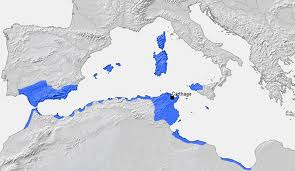
Carthaginian empire before wars with Rome


             Carthaginians founded trading colonies all over western Mediterranean and ruled over northern Africa from Libya to Gibraltar, part of Spain, whole Corsica and Sardinia, and nearly half of Sicily as well. Carthaginians did not like Pyrrhus (he had some notions and adventures in Sicily) and supported Rome in its defense against him. But there was a fundamental weakness in the empire building Carthaginian drive. They forced others – tribes and city-states – to pay taxes to them, but had no interest to integrate them into their system. No ‘Friends and Allies of Carthage’ existed, no graduated citizenship held as carrot for the future, and also no loyalty to Carthage, only subservience.

            The initial cause of Roman – Carthaginian conflict involved convoluted Greek politics in Sicily. Campanian mercenaries took over the city-state of Messana. Syracusan king Hiero wanted to oust them. The mercenaries appealed to a Carthaginian fleet.  Carthaginians helped, however they decided they want to keep Messana for Carthage and stayed. Messanians, or rather the mercenary rulers of Messana appealed for help to the Roman Senate. Roman Senate decided to do nothing. They did not want to tangle with the most powerful navy in the Mediterranean, especially since Rome had no navy. Not to mention they were not at all sympathetic to the Campanian mercenaries.

           The younger and less staid faction in the Roman Senate brought the Messanian request before the Popular Assembly, in the person Appius Claudius Caudex, grandson of the stubborn consul and censor from preceding chapter. Honed in the new art of persuasion, imported from southern Italy, he managed to convince the Assembly that they should help the Messanians. Thus proving, that the people generally, represented by the Assembly, were not bent on peace and brotherly love, as is commonly held by intellectuals today.  The 1st Punic War could start. Caudex led an army to Sicily, where he handily defeated Carthaginian garrison and the Syracusans, who allied themselves with the Carthaginians.

            Most of Carthaginian ships were in storage; they had to be refitted and crews hired and trained. This did not inspire confidence in the Syracusan king Hiero, because the most powerful navy in his world could not even prevent Romans from ferrying an army over the Strait of Messana to Sicily. He speedily signed a peace treaty with Rome for next 15 years and on top of it he helped the Romans with logistical support and with capturing some Carthaginian forts.

           Of course, the fleet was going to be a problem. Eventually, the Carthaginians would refit their warships and without their own navy, the Romans could not hope to prevent the Carthaginians raiding Italy with impunity. The triremes hired from the Greek city-states were somewhat helpful, but the latest in the naval warfare were quinqueremes, with five (quinque) men to an oar, and it was a heavy ship with proper heft behind the bronze beak just beneath the surface to ram enemy ships.

            Romans had one quinquereme, which they captured or found on the shore and in sixty days had one hundred of them built. This also meant that they had to build some simulators on land to train crews. Realising, after some unfortunate encounters with the Carthaginian navy that they need more advantage than speed in building, Romans invented the corvus (raven) – a large gangplank with a hook at the end to board enemy ship and to allow legionaries to do what they did best – to fight as if on land.
Qunquiereme

            In 260 BC a great naval battle took place not far from Messana, where the Roman navy defeated the Carthaginian navy, and took the beaks of the captured ships to decorate the Speakers platform in the Forum Romanum to prove to the Assembly, that the war was a good idea. In 258 BC the Carthaginian navy went down, that is down to the bottom, off the coast of Sardinia before the Roman fleet. Carthaginian council was so enraged that its commander was crucified. 

Diagram of corvus

            Many historians are puzzled that during that titanic, many years lasting struggle, the Carthaginians with all their naval expertise did not manage to develop a counter measure to the corvus.  Possibly the fact, that only the officer corps consisted of Carthaginians and the rest were mercenaries had something to do with it. They were hired to fight, not to think. Or they were more aware than the nautically reckless Romans that the heavy corvus, fastened to the mast, destabilised ships in stormy weather and they thought they’d  let nature take care of the Roman tactics.

            The Romans became very cocky. They decided to bring the war to northern Africa. M. Atilius Regulus received command for the invasion. This went bad in its entirety. Carthage hired a Spartan mercenary, Xanthippus, as a general, and his tactics defeated the Roman army in 255 BC. Roman fleet saved the remnants of Regulus’ army, but the fleet was partially destroyed by a storm and the captured consul Regulus was executed.

            After that, the main theatre of operations remained Sicily, from where the Carthaginians were previously thrown out. Since they did not believe in allies, only in subjugation, the minute Carthage was in trouble, the subjected peoples in Africa and Spain revolted, and Carthaginians spent a lot of time and energy to bring them back into the fold; or under the fold.

                In 249 BC happened an incident that served as a warning example and oratorical exercise on the dangers of impiety for generations of middle school boys. Publius Claudius Pulcher of the maverick Claudius family was elected to consulship and received the command of the fleet. Before a battle, every commander was supposed to see if the sacred chickens would eat, and thus prophesy success or failure in battle.  Chickens eating eagerly suggested success. If they were off their feed, commanders had to wait for another opportunity for battle. Well, the chickens did not want to eat that time and the consul threw them overboard, yelling “if they won’t eat, let them drink!’ He lost the battle, and the fleet.

             Irreverent people suggested though, that his defeat was caused rather by poor tactics than by wayward chickens. The same irreverent people hauled him to court on charges of incompetence and impiety, a handy charge. He was convicted and heavily fined, because Romans did not believe in killing bad commanders, rather making money off of them to compensate for losses caused by them.
Hamilcar Barca

            From then on, the war went badly for Rome. An excellent Carthaginian officer, Hamilcar Barca in command of 20 thousand mercenaries was dispatched to Sicily, and started to press the Romans back. The Romans had no more navies after the defeats in 249, whoever was to blame, chickens or bad commanders. Carthaginian navy regained its status and was able to supply the mercenaries in Sicily.

            Romans realised that their only chance for victory lay in the recovery of their naval power. However, there was no money for ships. Actually, for anything, the treasury under the temple of Saturn, the ancient god of wealth, was empty.  Rome’s doggedness and sheer pigheadedness (politely called perseverance) showed a way. Senators lined up on the Speakers platform in the Forum, since the 1st Punic war called the Rostra (ships' beaks), and asked citizens to lend money to the state. The consuls went ahead with all their own silver first as an example. In 242 BC 200 Roman ships arrived to Sicily. On a stormy morning they destroyed the Carthaginian fleet. The Carthaginian army in Sicily could no longer be supplied and the war was over. Carthage did not have another navy.
Carthage in 3rd cent. AD- note the excellent harbour

              Hamilcar Barca negotiated the peace treaty in 241 BC. Romans were well aware that their victory was a very close thing and did not press for severe terms.  However, whatever the terms, Sicily was henceforward Roman, the first Roman province outside of Italy proper. 
           
            Carthage was beset by other problems than mere loss of naval supremacy (never regained) and an indemnity to be paid to Rome.  They could not pay off the mercenaries who returned from Sicily and wanted their paycheck. Carthaginians did not have the money, so the mercenaries did, what they knew best – fought for it. With Carthage.


Carthaginian sacrificial altar. Romans were not fond of
the Carthaginians not only because of the war, but
because the Carthaginians practiced child sacrifices as well.
This fact was confirmed by archaeology.